
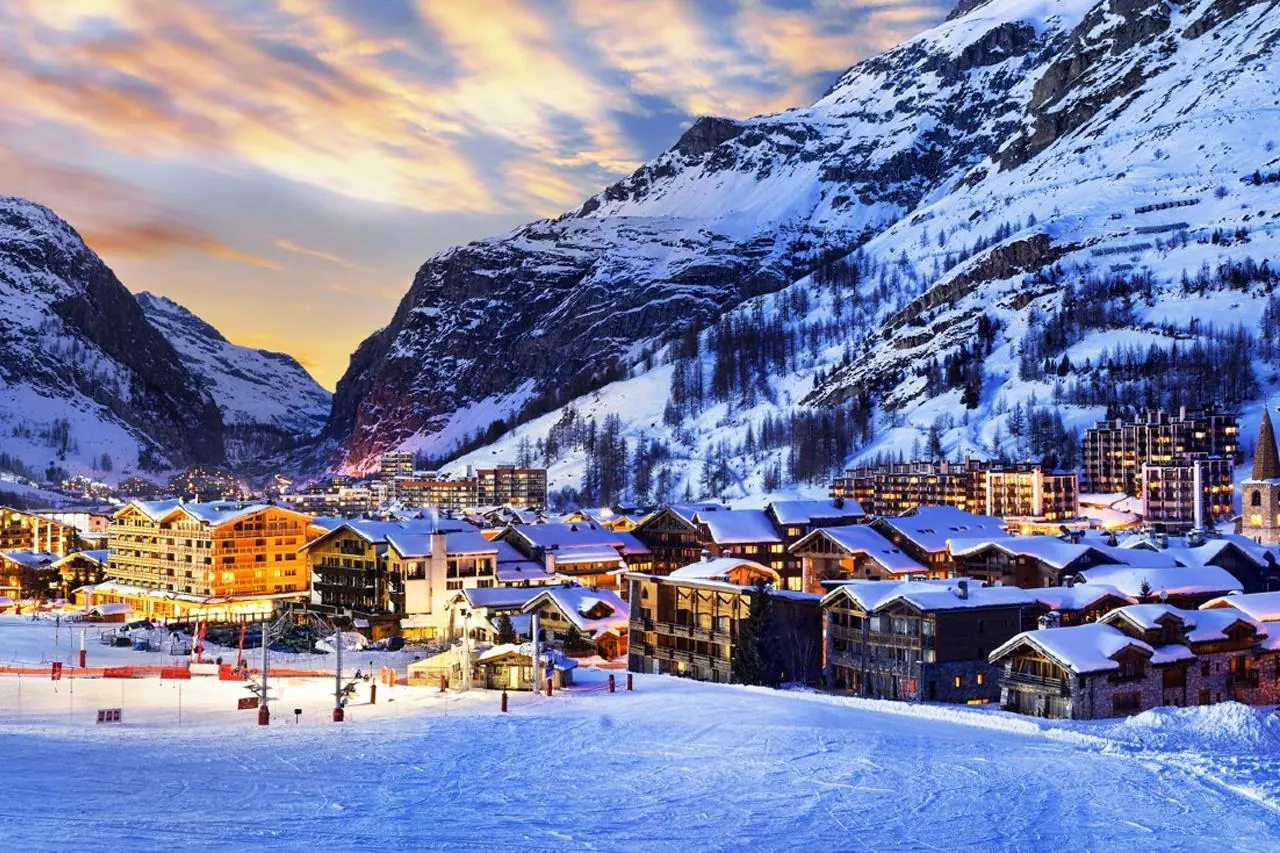
Geneva – Val d'Isère
Private Chauffeur from Geneva to Val d'Isère
About 180 km and 3 h 15 by road from Geneva Airport to Val d'Isère, at the very end of the Tarentaise valley, 1,850 m up.
- Door-to-Door Transfer
- Price Known Before Booking
- Baby & Booster Seats
- Available 24/7
Book your chauffeur
- Mercedes Benz E-Class: 25 km included per booked hour, then 3.00 CHF per extra km.
- Mercedes Benz S-Class: 25 km included per booked hour, then 6.00 CHF per extra km.
- Mercedes Benz V-Class: 25 km included per booked hour, then 3.60 CHF per extra km.
Add all your stops: the route is calculated by Google Maps and any extra kilometres are added to the price.
NB : Each time you change the information you will need to press the Price Estimate button.
Geneva to Val d'Isère with a private chauffeur: to the very end of the valley
Val d'Isère has to be earned. The resort lies at the end of the Tarentaise road, 1,850 metres up, where in winter the valley comes to a stop against the Col de l'Iseran. From Geneva Airport, allow 180 kilometres and about 3 h 15. This is the kind of journey on which a private chauffeur from Geneva to Val d'Isère genuinely changes the trip: three hours spent resting rather than driving a mountain road, and a direct arrival at the hotel instead of a string of trains and coaches.
This page explains how the travel time breaks down, what is particular about the Haute-Tarentaise road in winter, where the car drops you between La Daille and Le Fornet, and how to plan the timing of such a long drive.
Key points for the journey
- Price From CHF 675 one way in a Mercedes E-Class. Indicative price: the exact price is shown in the booking module.
- Distance About 180 km from Geneva Airport
- Travel time About 3 h 15 outside peak periods
- Route Annecy, Albertville, Moûtiers, Bourg-Saint-Maurice, then the D902 past the Tignes dam
- Altitude 1,850 m in the village, 1,930 m at Le Fornet
- Ski area Val d'Isère – Tignes, about 300 km of pistes
- Season Late November to early May
- Meeting point Geneva arrivals hall, with 60 minutes of waiting included
Three and a quarter hours, stage by stage
The first half of the route is shared by every resort in Savoie. From the airport the car reaches Annecy on the A41, follows the lake and then joins Albertville through Faverges and Ugine, which takes roughly 1 h 35. When the lakeshore is congested, the chauffeur stays on the motorway and goes via Chambéry.
From Albertville, the dual carriageway follows the Isère up to Moûtiers in about twenty minutes. Beyond that point most vehicles have already turned off for Les 3 Vallées, and the road becomes a two-lane trunk road again. It passes through the Siaix tunnel, runs below Aime and La Plagne, and reaches Bourg-Saint-Maurice half an hour later.
After Bourg-Saint-Maurice: the Haute-Tarentaise
The last thirty-one kilometres are the most spectacular. The D902 leaves Bourg-Saint-Maurice through Séez, where the Petit-Saint-Bernard pass road branches off, then climbs along a ledge above the Isère. You pass through Sainte-Foy-Tarentaise and a series of hamlets with stone-slab roofs before catching sight of the great curved wall of the Tignes dam. The road then skirts the Lac du Chevril, beneath which lies the old village of Tignes, flooded in 1952, through a succession of tunnels and avalanche galleries. At the exit of the last tunnel, the buildings of La Daille announce Val d'Isère. This section takes about 45 minutes.
A high-mountain road
The D902 is wide and carefully maintained, but it remains a high-altitude road. Three realities are worth knowing.
- Equipment. Winter tyres or chains are required by the “Loi Montagne” in Savoie from 1 November to 31 March. Above Sainte-Foy the surface is often white in midwinter, and our vehicles go up properly equipped.
- Preventive closures. After very heavy snowfall the road may be closed for a few hours between the dam and the resort while the avalanche paths are made safe. It is rare, always announced, and reopening is quick. The chauffeur follows the road reports and adapts the departure time.
- Pace. On a snowy day you drive behind the snowploughs. The final 45 minutes can then become an hour or more.
These constraints are one more reason to hand the wheel to a driver who makes this climb regularly.
From La Daille to Le Fornet: where the car stops
The resort stretches for five kilometres along the infant Isère, and several districts can be distinguished.
- La Daille (1,785 m): the first district you reach, at the foot of the Funival funicular and of the Oreiller-Killy run, a regular World Cup venue.
- Le Crêt: between La Daille and the centre, an area of chalets beside the road.
- The centre: Avenue Olympique, the old village around its Baroque church, and Val Village, a group of stone and timber buildings where hotels and shops are concentrated. The snow front, where the Solaise and Bellevarde lifts start, is a few minutes' walk away.
- Le Joseray, Le Châtelard and La Legettaz: the residential districts at the top of the village, sought after for chalets close to the pistes.
- Le Laisinant: a peaceful hamlet on the road to Le Fornet.
- Le Fornet (1,930 m): the last inhabited village in the valley and the point where the road ends in winter, at the cable car leading towards the Pissaillas glacier.
In winter, parking is tightly controlled in the resort, but setting passengers down in front of a hotel or chalet is no problem. In the upper lanes the chauffeur stops at the nearest accessible point and carries the luggage with you.
A village of champions
Val d'Isère was not built from scratch: it was an isolated mountain village, with a seventeenth-century church, before skiing arrived in the 1930s. The resort went on to give French skiing several of its great names: Henri Oreiller, the first Olympic downhill champion in 1948, the Goitschel sisters, and then Jean-Claude Killy, triple gold medallist at Grenoble in 1968.
The Face de Bellevarde, which plunges towards the village, staged most of the men's Alpine skiing events of the 1992 Games and the 2009 World Championships. Every December, the Critérium de la Première Neige brings the World Cup elite to the resort. That racing culture draws a clientele of very good skiers, largely French, British and Scandinavian.
Bellevarde, Solaise, Le Fornet and Tignes
The ski area, shared with Tignes, has about 300 kilometres of pistes between 1,550 and more than 3,400 metres. On the Val d'Isère side, three sectors follow one another. Bellevarde is the largest and gives access to Tignes over the Tovière ridge. Solaise, facing the village, has a sunny plateau where beginners learn to ski at altitude. Le Fornet, wilder, rises towards the Pissaillas glacier and the slopes of the Col de l'Iseran.
Altitude ensures good snow over a long period, and the off-piste, skied with a guide, is among the most varied in the Alps. At the top of its gondola, La Daille is also home to the first Folie Douce, where the habit of dancing on the terrace at the end of the day began.
A long season, and a summer of its own
The lifts generally open at the end of November and close at the beginning of May: Val d'Isère is one of the resorts where you can ski latest in spring. The quietest periods on the road are January outside the holidays and the month of April.
In summer the Col de l'Iseran, at 2,764 metres, reopens towards the Maurienne valley and attracts cyclists and motorcyclists to the highest paved road in the Alps. The drive from Geneva is then on dry tarmac, with a very stable travel time.
Planning a journey of more than three hours
A few habits make the trip more pleasant.
- Land early or late on Saturdays. During the Christmas and February holidays the valley is saturated from 9 am to 5 pm, and the drive can then take 4 h 30 to 5 h. A morning or evening flight brings it back close to its normal length.
- Plan a break. Albertville and Bourg-Saint-Maurice are convenient places to stop. Tell the chauffeur as you get in, or mention it when booking if it is for a meal.
- Be generous on the return. We advise leaving Val d'Isère six hours before take-off on weekdays, and seven hours or more on holiday Saturdays.
- Think about the next day's flight. When heavy snow is forecast, coming down the day before and sleeping in Geneva protects your flight.
The vehicle, when you spend three hours on board
Over this distance, the choice of vehicle is first of all a question of comfort. The Mercedes S-Class is the most restful for two or three passengers. The E-Class suits a single traveller or a couple with ordinary luggage. The V-Class van lets a family travel together, with ski equipment and room to move. The Sprinter carries a group of friends, a team or a club in a single vehicle.
Baby seats and boosters are lent free of charge; give the children's ages. Mention ski bags and outsize luggage as well. The price of each vehicle is shown in the form before you confirm anything.
During your stay
Within the resort, free shuttle buses link La Daille, the centre and Le Fornet. For leaving Val d'Isère, the hourly option, offered from two hours, comes in useful: Tignes is some twenty minutes away by the dam road, Sainte-Foy twenty-five minutes, and Bourg-Saint-Maurice with the Les Arcs funicular three quarters of an hour.
Practical guide : Geneva Airport to Val d'Isère: Travel Time, Route and Transport Options
Frequently asked questions
Frequently asked questions about the Geneva – Val d'Isère journey
How long does it take from Geneva Airport to Val d'Isère?
About 3 h 15 for 180 kilometres in dry weather and outside peak periods. On a winter-holiday Saturday in the daytime it can reach 4 h 30 to 5 h.
Is the road ever closed?
Very rarely, and only for a few hours, after heavy snowfall, between the Tignes dam and the resort. The chauffeur checks before leaving and adjusts the timing with you.
Are your vehicles equipped for snow?
Yes. Winter equipment is compulsory in Savoie from 1 November to 31 March, and the Haute-Tarentaise climb is unthinkable without it.
Will you drop me at La Daille, Le Fornet or Le Laisinant?
Yes, anywhere in the resort. Enter the full address: it is what the price is calculated on.
Can we stop during the journey?
Yes. A short break is agreed with the chauffeur; a longer stop, for a meal for example, is arranged at the time of booking.
Where do I find the chauffeur when my flight arrives?
He waits in the arrivals hall of Geneva Airport holding a sign with your name, then helps you take the luggage to the vehicle.
What happens if the plane is delayed?
Thanks to flight tracking, the pick-up is reset to the actual landing time. From then on, 60 minutes of waiting are included.
Does the fare go up if the drive takes five hours on a Saturday?
No. The price of the journey is the one shown at booking. Any road charges and parking are payable by the client under our terms and conditions, unless the offer states otherwise.
How much luggage can we bring?
As much as the chosen vehicle can hold: declare your suitcases and ski bags and we will point you towards the saloon, the van or the minibus.
When should I leave Val d'Isère for a flight from Geneva?
Six hours before take-off on a normal day. At least seven hours on a school-holiday Saturday.
What are the payment methods?
Payment is made in advance, online, by Visa, Mastercard, Maestro or American Express card, through Stripe.
And if I have to cancel?
Cancellation is refunded at 100% up to 72 hours before departure and at 50% from 72 to 48 hours, and gives no right to a refund under 48 hours or if the passenger does not appear.
Ready to book your chauffeur?
Get your price online in a few seconds, or contact us on WhatsApp — we answer 24/7.