
International Geneva
Diplomatic Chauffeur in Geneva: Delegations, Missions and International Organisations
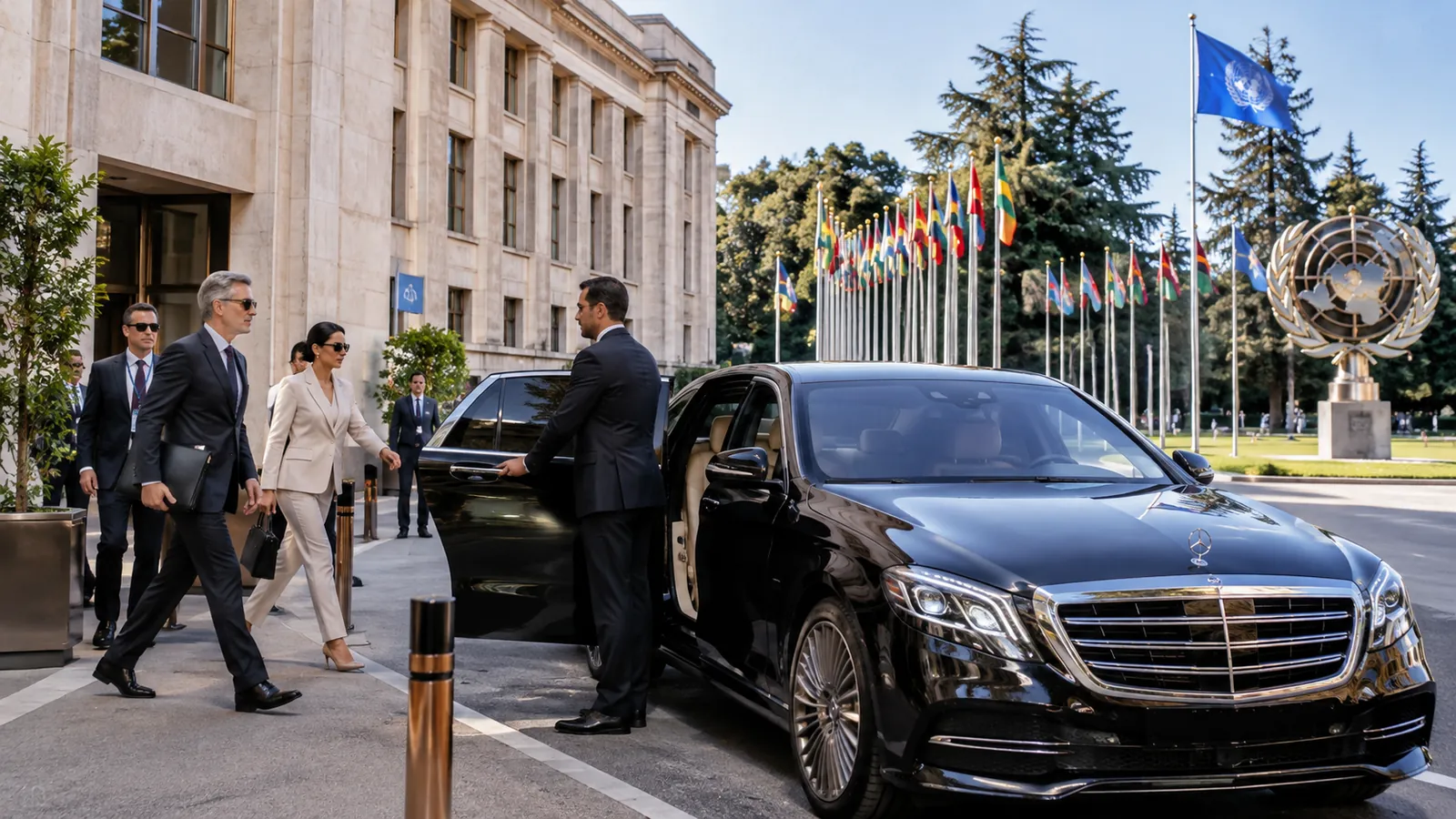
During a session, a ministerial visit or a conference, cars and chauffeurs who know the Nations district door by door.
- Absolute Discretion
- Premium Fleet
- Secure Payment
- Available 24/7
Book your chauffeur
- Mercedes Benz E-Class: 25 km included per booked hour, then 3.00 CHF per extra km.
- Mercedes Benz S-Class: 25 km included per booked hour, then 6.00 CHF per extra km.
- Mercedes Benz V-Class: 25 km included per booked hour, then 3.60 CHF per extra km.
Add all your stops: the route is calculated by Google Maps and any extra kilometres are added to the price.
NB : Each time you change the information you will need to press the Price Estimate button.
Diplomatic chauffeur in Geneva: serving delegations and organisations
Three times a year the Human Rights Council sits for several weeks. In May, health ministers from all over the world gather for the WHO Assembly. In between, trade negotiations, technical conferences and official visits follow one another without a pause. In this city a diplomatic chauffeur in Geneva is no luxury: it is one of the cogs that allow a delegation to keep a diary made up of bilateral meetings set twenty minutes apart.
Geneva Chauffeur Service places chauffeur-driven Mercedes vehicles at the disposal of permanent missions, delegations travelling from capitals, international organisations and non-governmental organisations. We are a private company: we work as a reinforcement to the missions' own resources, or in their place when a visiting delegation has none. This page describes the district as a driver sees it, the rules of access that apply to a hired car, and the way a session week is organised in practice.
The essentials for delegations
- Price Transfers from CHF 100. Hourly hire: CHF 100 per hour, 2 hours minimum (CHF 200). Prices in a Mercedes E-Class
- Clients Permanent missions, government delegations, international organisations, NGOs, foundations, law firms
- Area Place des Nations, Avenue de la Paix, Avenue Appia, Route des Morillons, Rue de Lausanne, Le Grand-Saconnex
- Options Airport welcome, single journeys, car at your disposal by the hour from 2 hours, multi-vehicle arrangements
- Vehicles Mercedes S-Class and E-Class for heads of delegation, V-Class and Sprinter for teams
- Airport Flights tracked, sign in the arrivals hall, 60 minutes of waiting covered after landing
- Chauffeurs Experienced, discreet, speaking several languages
- Access to compounds Drop-off at the public entrances; entry into the grounds depends on permits issued by the organisation
International Geneva, street by street
The city hosts some forty international organisations, the representations of nearly 180 states and several hundred non-governmental organisations. Almost all of it is concentrated on the right bank, between the lake and the airport, in an area that planners call the Jardin des Nations. To a chauffeur it reads as a sequence of addresses.
Place des Nations. Recognisable by its Broken Chair, it faces the historic entrance to the Palais. The International Telecommunication Union and the World Intellectual Property Organization stand beside it; the headquarters of the UN Refugee Agency is a few minutes away on foot. It is also the terminus of tram 15 and the usual place for rallies: on some days traffic there is diverted.
Avenue de la Paix. It climbs from Rue de Lausanne towards Pregny alongside Ariana Park. Here you find the Pregny Gate of the Palais des Nations, the headquarters of the International Committee of the Red Cross directly opposite, and lower down the World Meteorological Organization.
Avenue Appia. On the higher ground, it leads to the headquarters of the World Health Organization.
Route des Morillons. The International Labour Office occupies a vast building in the middle of a park; the International Organization for Migration is its neighbour.
Rue de Lausanne. By the lake, the Centre William Rappard houses the World Trade Organization. Closer to the centre, the Sécheron district brings together the Maison de la Paix and several institutes.
Rue de Varembé and Chemin Louis-Dunant. The Centre International de Conférences Genève and many permanent missions are located here, a few steps from one another.
Le Grand-Saconnex. Towards the airport, the Global Health Campus is home to Gavi and the Global Fund, among others; the Inter-Parliamentary Union has its headquarters nearby.
Further out. CERN in Meyrin, on the border; the World Economic Forum in Cologny, across the lake; missions and residences in Pregny-Chambésy, Bellevue and on the left bank.
Since 2024, the Route des Nations, largely underground, has linked the Grand-Saconnex motorway junction directly with the district: the run from the airport no longer depends so heavily on the streets of Le Petit-Saconnex.
The Palais des Nations: what a chauffeur needs to know
The United Nations' European headquarters, built in the 1930s for the League of Nations, spreads across Ariana Park. You do not walk into it as you would an office building.
- The Pregny Gate, on Avenue de la Paix, is the entrance for conference participants and visitors. This is where badges are issued or activated on first entry, after a security check. Allow time on the first morning of a session: the queue can be long.
- The gate on Place des Nations is a pedestrian access.
- Vehicles enter the compound only with a permit, requested through the permanent mission concerned. A chauffeur-driven car booked for a delegation therefore drops its passengers outside, at the gate they need to use.
- Opening hours. The gates are open on working days, from early morning until about 7.30 pm. For a sitting that runs late, agree on a precise collection point outside.
The surroundings of the Palais are currently affected by the works to extend the tram line towards Le Grand-Saconnex. Our chauffeurs allow for this; it is still wise to add a few minutes at rush hour.
The other organisations apply comparable rules: a check at the entrance, a drop-off area in front of the building, and parking reserved for authorised vehicles. Give us the name of the organisation and, if you know it, of the entrance; the chauffeur will know where to stop.
Who calls on us, and in what circumstances
Permanent missions
A mission has its own vehicles, in a number worked out for day-to-day needs. When a minister arrives with fifteen staff, or three visits fall in the same week, that fleet is no longer enough. We then supply the additional cars and chauffeurs, for a few hours or for the whole visit, under the coordination of the mission's protocol section.
Delegations from capitals
Experts, senior officials, members of parliament: they come for a session and do not always know the city. A car at their disposal spares them from finding their way between the hotel, the Palais, the mission and the venue of a reception.
International organisations
Their travel or protocol units arrange the visits of board members, speakers, prize-winners and partners. The request is most often for an airport welcome and a few journeys during the stay.
NGOs, foundations and law firms
They receive donors, public figures invited to speak, witnesses, arbitrators. The needs are occasional, but the demand for punctuality and discretion is the same.
Protocol, as it applies to the car
Protocol is not a matter of ceremony; it is a way of avoiding awkwardness. Our chauffeurs know its everyday rules.
- The seat of honour is the rear right. The chauffeur stops the car so that this side opens towards the entrance or towards the person doing the welcoming.
- The order of vehicles in a motorcade follows the one set by the delegation's protocol officer; it is confirmed before departure, not on the way.
- The arrival time at an audience or a signing is set to the minute. Arriving too early is as awkward as arriving late: the chauffeur adjusts his pace or waits nearby.
- Discretion is absolute. Conversations held on board, documents glimpsed and the names of the people met are repeated to nobody.
- Neutrality. The chauffeur comments neither on current affairs nor on anyone's positions.
One useful clarification: our vehicles are private cars, with no diplomatic plates and no special privilege. They obey traffic and parking rules like any other vehicle.
The calendar of sessions: the weeks to plan for
- Human Rights Council: three regular sessions a year, at the end of winter, in early summer and in autumn.
- World Health Assembly: every year in May.
- International Labour Conference: every year in June.
- Meetings of the WTO, ITU, WIPO and the other agencies: spread across the year, with peaks in spring and autumn.
- Talks and summits: sometimes announced only a few days ahead, they tie up hotels and vehicles overnight.
During these periods the city runs short of rooms and cars. Delegations that return every year book as soon as the session dates are published; passenger names can be supplied afterwards.
A delegation's arrival at the airport
The airport is less than five kilometres from Place des Nations. Chauffeurs wait in the arrivals hall with a sign in the name of the delegation, the mission or the head of delegation, as you instruct, and take charge of the luggage. As flights are tracked, a delay changes nothing in the arrangements: the hour following landing is covered.
When the mission has obtained a protocol welcome from the airport for a dignitary, the meeting point is different; the protocol section only needs to tell us where, and the chauffeur goes there.
For a large delegation, the usual arrangement combines a saloon for the head of delegation, a van or minibus for staff and, if necessary, a vehicle for the luggage. Everyone knows before landing which car they are to board.
A session day, hour by hour
Take a delegation of six staying on the quays. At 8.15 am, departure from the hotel by van; at 8.35, drop-off at the Pregny Gate, with the margin needed for the security check. At 11 am, the head of delegation comes out for a bilateral meeting at a mission on Chemin Louis-Dunant: the saloon is waiting on Avenue de la Paix. At 1 pm, a working lunch on Rue de Lausanne. At 3 pm, back to the Palais. At 6.30 pm, the whole delegation is collected, calls at the hotel, then attends a reception at 7.30 pm at a residence in Pregny-Chambésy. At 10 pm, the last return.
Two vehicles booked by the hour cover this day. No journey was ordered separately, and the inevitable changes of timing are settled by a message to the chauffeur.
Outside Geneva: diplomacy's other addresses
A delegation's work does not always stop at the cantonal boundary. From Geneva Airport, in normal traffic:
- Divonne-les-Bains and the Pays de Gex, where many delegates stay: 19 km, about 25 minutes
- Lausanne, seat of the International Olympic Committee and the Court of Arbitration for Sport: 63 km, about 55 minutes
- Montreux, a town of conferences and talks: 93 km, about 1 hour 15
- Bern, the federal capital, home to the Swiss government and the embassies: 157 km, about 2 hours
- Lyon, headquarters of Interpol: 153 km, about 2 hours
- Basel, seat of the Bank for International Settlements: 251 km, about 3 hours 10
- Turin, where the ILO has its training centre: 256 km, about 3 hours 40
- Strasbourg, seat of the Council of Europe: 391 km, about 4 hours 40
- Davos, for the World Economic Forum's annual meeting in January: 424 km, about 5 hours 20
On these routes the car offers what the train does not always allow: speaking freely, making calls, rereading a speech.
Summits and high-level visits
Geneva regularly hosts meetings that transform the city for a day or two. During the June 2021 summit at Villa La Grange, the quays and part of the left bank were closed to traffic. In such circumstances the police set perimeters and routes; only vehicles accredited by the organiser pass the barriers.
Our role is then to prepare: to know the announced closures, to suggest earlier departure times, and to plan a drop-off point at the edge of the perimeter if the car is not accredited. If your delegation obtains passes for its vehicles, send us the organiser's requirements as soon as you receive them.
Staying across the French border during sessions
For want of rooms in Geneva, many delegates stay in Ferney-Voltaire, Divonne, Saint-Genis-Pouilly or Annemasse. The border is crossed in a few minutes outside rush hours, and a good deal more slowly in the morning, when cross-border commuters are entering Switzerland. A departure set for 7.45 rather than 8.15 often makes all the difference. Each passenger should carry a passport and, where applicable, a visa and Swiss legitimation card.
Booking for a delegation: procedure and conditions
The request may come from a mission's protocol section, an organisation's travel unit or a member of the delegation. For a single journey, the online booking shows the price of each vehicle before payment. For an entire session, send the dates, the number of people and the places: an offer is drawn up for the whole arrangement.
Payment is made in advance by card, on a secure payment page; the booking is made out in the name of the mission or the organisation. Parking and any road charges are payable in addition where the offer does not expressly include them.
Diplomatic diaries are uncertain by nature. Our terms provide for a full refund for any cancellation notified at least 72 hours before the service, a half refund between 72 and 48 hours, and no refund after that or if the passengers fail to appear. When a visit hangs on a political decision, it is better to book for the likely date and confirm or cancel three days beforehand.
Practical guide : Getting to the Palais des Nations in Geneva: Gates, Transport and Practical Tips
Frequently asked questions
Frequently asked questions about diplomatic chauffeurs in Geneva
Can your vehicles enter the grounds of the Palais des Nations?
No, unless the permanent mission has obtained a permit for the vehicle in question. As a rule the chauffeur drops passengers at the Pregny Gate, on Avenue de la Paix.
At which entrance should a delegate be dropped on the first day?
At the Pregny Gate, where conference badges are issued or activated. Allow a margin for the security check.
Do your cars carry diplomatic plates?
No. They are private vehicles, subject to the ordinary rules of traffic and parking.
Do you work directly with permanent missions?
Yes, most often with their protocol section or administration, to supplement their own vehicles during visits and sessions.
Can a car be booked for the full length of a session?
Yes. Hire is booked by the hour, from two hours, day after day, at the times you set.
How far ahead should we book for the World Health Assembly or the Human Rights Council?
As soon as the dates are published. These are the most sought-after periods of the year; passenger names can follow.
Do the chauffeurs know the rules of protocol?
They know its everyday practice: seat of honour at the rear right, order of a motorcade, punctuality to the minute, complete reserve.
Which languages do the chauffeurs speak?
French and English, and for several of them other languages too. Tell us which one you would like; we take it into account as far as possible.
Where does the delegation find its chauffeurs at the airport?
In the arrivals hall, after customs, under a sign bearing the name you have given. If a protocol welcome is arranged by the mission, the chauffeur goes to the point it tells us.
What if the delegation's flight is late?
The chauffeurs appear at the actual landing time, since the flight is tracked, and wait up to sixty minutes at no additional cost.
Can you carry a delegation of fifteen or twenty people?
Yes, with several vehicles: a saloon for the head of delegation, vans and minibuses for the staff. Give us the exact make-up of the group.
Do you drive to Bern?
Yes. The federal capital is 157 km from Geneva Airport, about two hours by road; the car can wait there and bring you back.
Do you collect delegates staying across the French border?
Yes, in Ferney-Voltaire, Divonne, Saint-Genis-Pouilly or Annemasse. We suggest a departure time that allows for the morning wait at the border post.
What do you do when roads are closed for a summit?
We adapt routes and timings to the perimeters announced by the police. Access to closed areas remains limited to vehicles accredited by the organiser.
How does a mission or an organisation pay for the service?
By card, before the service, on an online page secured by Stripe. Visa, Mastercard, Maestro and American Express are accepted.
A visit is postponed: what happens to the booking?
Tell us without delay. At 72 hours or more, the refund is complete; between 72 and 48 hours, it is 50%; under 48 hours, the service remains payable.
Does the service run in the evening and at weekends?
Yes, at any hour and every day by reservation, including for late receptions and departures at dawn.
Ready to book your chauffeur?
Get your price online in a few seconds, or contact us on WhatsApp — we answer 24/7.