
Ski resorts
Ski Chauffeur from Geneva to the Alpine Resorts
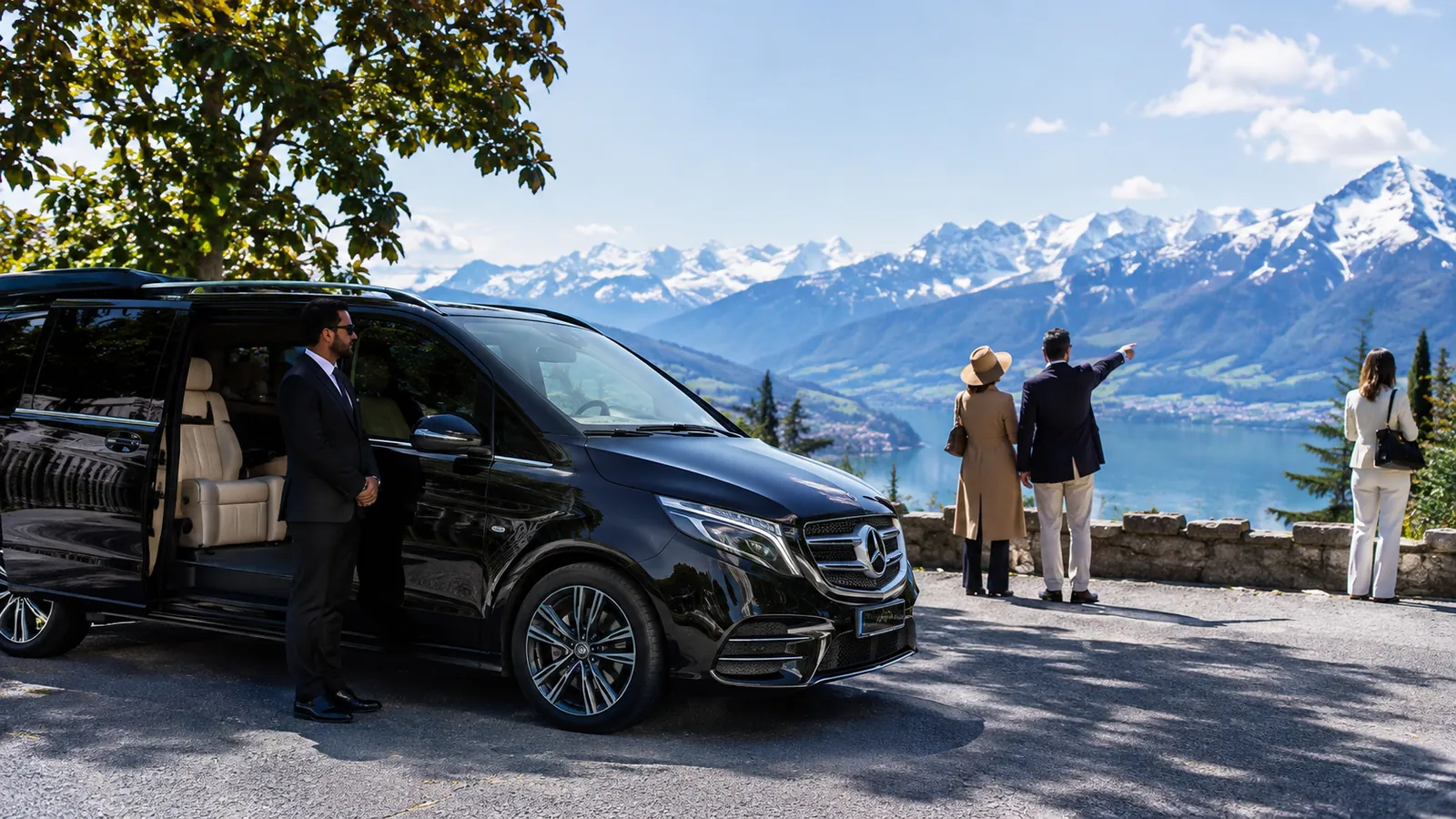
Four roads lead from Geneva to the snow. Your chauffeur knows each of them bend by bend and sets you down, skis and all, at the chalet door.
- Mountain-Ready Vehicles
- Door-to-Door Transfer
- Luggage Assistance
- Available 24/7
Book your chauffeur
- Mercedes Benz E-Class: 25 km included per booked hour, then 3.00 CHF per extra km.
- Mercedes Benz S-Class: 25 km included per booked hour, then 6.00 CHF per extra km.
- Mercedes Benz V-Class: 25 km included per booked hour, then 3.60 CHF per extra km.
Add all your stops: the route is calculated by Google Maps and any extra kilometres are added to the price.
NB : Each time you change the information you will need to press the Price Estimate button.
A private ski chauffeur from Geneva to the resorts
Few airports in the world are as well placed for skiing as Geneva. Within three hours by road you can reach several dozen resorts spread over two countries: Haute-Savoie and Savoie on one side, the Vaud Alps, Valais and the Gstaad region on the other. Our ski chauffeur service from Geneva links the arrivals hall to the door of your hotel or chalet, with no change of vehicle and no passengers other than your own party.
This page is not about one resort in particular. It explains how a transfer to the mountains is organised in winter: which road leads where, what the law requires of vehicles, where the car has to stop in car-free villages, how skis are loaded and why the departure time matters as much as the distance.
The ski transfer in seven points
- Price Transfers from CHF 100. Hourly hire: CHF 100 per hour, 2 hours minimum (CHF 200). Prices in a Mercedes E-Class
- Nearest resorts La Clusaz, Le Grand-Bornand, Les Carroz: about 1 h 10 from the airport
- Major resorts Chamonix and Megève 1 h 20, Verbier 2 h 10, Gstaad 2 h 15, Courchevel 2 h 30
- Equipment Vehicles prepared for snow, compliant with French and Swiss rules
- Gear Ski and snowboard bags accepted; tell us how many
- Children Child seats and boosters fitted free on request
- Flights Landing tracked, 60 minutes of waiting at no charge afterwards
- Car-free villages Drop-off in Täsch for Zermatt, in Lauterbrunnen for Wengen, at the entrance to Avoriaz and Saas-Fee
Four corridors to the snow
From Geneva, every resort is reached by one of four main axes. Knowing which one serves yours helps to understand the length of the journey and its weak points.
The Autoroute Blanche: Haute-Savoie
The A40 climbs the Arve valley from the border to the foot of Mont Blanc. Each exit opens onto a massif. At Bonneville you turn off for the Aravis: La Clusaz (58 km) and Le Grand-Bornand (55 km), about 1 h 10 away. At Cluses, one road climbs to Les Carroz and Flaine in the Grand Massif, another runs to Taninges, then Samoëns in one direction, Les Gets and Morzine in the other: allow 1 h 20 for Les Gets, 1 h 25 to 1 h 30 for Morzine, 1 h 45 for Avoriaz. At Sallanches you leave the motorway for Combloux, Megève and Saint-Gervais, each 1 h 15 or 1 h 20 away, and for Les Contamines a little further on. At the head of the valley, Chamonix lies 90 km and 1 h 15 to 1 h 20 from the airport.
This is the shortest corridor and the one where the access roads are least long. Châtel is the exception: you go up through Thonon and the Abondance valley, or through Switzerland and the Pas de Morgins, in 1 h 40 to 1 h 45.
The Tarentaise: via Annecy and Albertville
For Savoie, you cross the border at Bardonnex, skirt Annecy and make for Albertville. From there a dual carriageway follows the Isère up to Moûtiers, the crossroads of the Three Valleys: Méribel (138 km, about 2 h 25), Courchevel (145 km, about 2 h 30), Saint-Martin-de-Belleville, Les Menuires and Val Thorens, the highest of all, at 157 km and roughly 2 h 45. Carrying on up the valley you reach Aime, where the road to La Plagne begins (2 h 40), then Bourg-Saint-Maurice at the foot of Les Arcs (2 h 50). Right at the end, beyond the Tignes dam, the road finishes in Val d'Isère: 180 km and 3 h 15 to 3 h 20 in quiet conditions.
This corridor is the most exposed to congestion. Between Albertville and Moûtiers, every holidaymaker bound for the Three Valleys, La Plagne, Les Arcs, Tignes and Val d'Isère shares the same road.
Two Savoie resorts do not fit this pattern. Valmorel is reached by leaving the dual carriageway just before Moûtiers, in about 2 h 20. Les Saisies, for its part, is quicker to reach by the Autoroute Blanche, Megève and Flumet: allow 1 h 50. Further south, the Oisans is approached through Chambéry and Grenoble: Alpe d'Huez, at the top of its twenty-one hairpin bends, and Les Deux Alpes are a little over three hours from Geneva Airport.
The Rhône valley: the Vaud Alps and Valais
On the Swiss side, the motorway follows the north shore of the lake through Lausanne, Vevey and Montreux, then enters the Rhône valley. The resorts come one after another like stops on a line. From Aigle: Villars and Leysin (1 h 40), Les Diablerets (1 h 45). From Monthey: Champéry, on the Swiss side of the Portes du Soleil. From Martigny: Verbier, via Sembrancher and Le Châble (162 km, about 2 h 10). From Sion: Nendaz. From Sierre: Crans-Montana (about 2 h 30) and, in the Val d'Anniviers, Grimentz and Zinal. Higher still come Leukerbad and then Visp, where a side valley leads to Täsch for Zermatt and to Saas-Fee, around three hours from Geneva.
Almost all of this journey is on motorway, with no border and no pass: it is the most predictable of the four.
Gstaad and the Bernese Oberland
For Gstaad, you leave the lakeside motorway at Vevey, climb towards Bulle and the Gruyère district, then cross the Pays-d'Enhaut through Château-d'Œx and Rougemont: 151 km, about 2 h 15. The Jungfrau resorts are reached via Bern and Interlaken: Grindelwald in a little over three hours, Lauterbrunnen, where the train to Wengen starts, in slightly less.
The resorts of Graubünden, such as St. Moritz, Davos and Klosters, are more than five hours from Geneva: we are happy to drive you there, but Zurich Airport is considerably closer to them.
From touchdown to the chalet: how it unfolds
Your chauffeur is waiting in the arrivals hall with a name sign. While you collect the skis, he brings the vehicle round. Loading follows a set order: ski bags first, suitcases next, rucksacks and jackets within easy reach. Ten minutes after leaving the terminal you are on the motorway.
On a drive of more than two hours, a break is possible at the halfway point; you only have to ask. As the resort comes near, the chauffeur gives you the expected arrival time so that you can alert the front desk or whoever is handing over the keys. Once there, he parks as close to the entrance as he can, unloads with you and does not drive off until the door has been opened and everything is inside.
Chauffeur, shared shuttle, hire car or train: a comparison
A shared shuttle groups passengers from several flights and serves several addresses. It sometimes waits for the next aircraft and stops in resort at other lodgings before yours. It is an economical answer for a solo traveller with no timing constraint.
A hire car gives freedom once you are there, but it leaves you with the driving on snow, the possible fitting of chains, the Swiss vignette and the parking, which in high-altitude resorts is often paid and under cover, and where the car then sits unused all week.
The train works well to a handful of Swiss resorts, at the cost of one or two changes with luggage and equipment in tow.
A private chauffeur is the only formula that collects you as you leave the aircraft and sets you down at the door, at the time you have chosen. Divided among the occupants of a van, its price bears useful comparison with the others, especially once the hours saved on a short break are counted.
Car-free villages: where the chauffeur stops
Several resorts have banished the motor car. The journey then ends by other means, which it is best to know about beforehand.
- Zermatt. The road stops at Täsch. A shuttle train covers the last five kilometres in about twelve minutes; at the station, hotels send their electric vehicles.
- Saas-Fee. Cars stay in the car park at the entrance to the village. Electric vehicles take over from there.
- Wengen and Mürren. You leave the road at Lauterbrunnen, where a rack railway climbs to Wengen.
- Avoriaz. The resort is pedestrian and skiable: drop-off at the reception area, then a horse-drawn sleigh or a tracked vehicle to your residence.
- Verbier. The resort can be reached by car, but some guests prefer to be set down in Le Châble and ride up by gondola, particularly when the road is busy.
In each case the chauffeur helps you unload and walks with you to the connection point.
Winter on the road: rules and equipment
Driving to a resort in January has little in common with a summer trip, and the regulations reflect that.
In France, the Loi Montagne requires, from 1 November to 31 March, winter tyres or chains on board in the mountain municipalities designated by the prefects. Haute-Savoie, Savoie and Isère are covered, in other words every resort we serve.
In Switzerland, no text sets a date, but drivers must keep control of their vehicle in all circumstances, and a blue sign showing a chained wheel makes chains compulsory on certain stretches on snowy days. Motorways also require the annual vignette.
Our vehicles are equipped for these conditions and carry the vignette. That leaves the weather: during a heavy snowfall an access road may be slowed, or even closed for a few hours for preventive avalanche control. The chauffeur checks before leaving, chooses the route accordingly and warns you if the arrival time needs to be revised.
Skis, bags and suitcases: which car to choose
Equipment decides the vehicle far more than the number of passengers does.
- E-Class or S-Class. A saloon suits a couple who hire their skis in resort and travel with two suitcases and boot bags. A 1.80 m ski bag does not fit in a saloon boot.
- V-Class. This is the ski vehicle par excellence: ski bags slide in lengthways, suitcases stack behind, and passengers keep all their room.
- Sprinter. For two families, a group of friends or a team, with everyone's gear.
When booking, count suitcases, ski or snowboard bags, boot bags and any pushchairs separately. A bag left off the list ends up on somebody's knees for two hours.
At the airport, skis generally arrive on a belt reserved for outsize baggage, a few minutes after the suitcases. The chauffeur knows this and waits; the hour following touchdown is not charged to you.
Saturday, changeover day
In most resorts, rentals run from Saturday to Saturday. On that day those leaving meet those arriving and the access roads clog up, above all during the February holidays, which are spread over four weeks in France, and between Christmas and New Year.
- Land early. A flight that touches down before 9 am lets you reach the Tarentaise ahead of the bulk of arrivals.
- Or late. After 5 pm the wave has passed; you arrive in time for dinner.
- Shift by a day. More and more accommodation accepts a Sunday or midweek arrival: the road is then clear.
- Allow plenty of time. On a February Saturday it is not unusual for Geneva to Val d'Isère to take one to two hours longer than normal.
The return: what time to leave the resort
This is the question we are asked most. The answer is a sum: the normal journey time, a margin for traffic and weather, and the airline's check-in deadline, which is longer when there are skis to drop off.
For a 3 pm flight from Méribel on a holiday Saturday, that gives a departure at about 8.30 am: 2 h 25 on the road, an hour and a half of margin, two and a half hours at the airport. On a Tuesday in January, 10 am is enough. Your chauffeur suggests the right time for the day; one more coffee at the airport is better than a missed flight.
One way, return, or a day's skiing
A one-way transfer links the airport, a Geneva hotel or a railway station to the resort. A return is booked in one go, with the date and flight of the journey back. Between two resorts, from Megève to Courchevel for instance, a direct transfer saves going back down to Geneva.
A day's skiing appeals to business travellers passing through: leave the hotel at 7.30 am, reach Chamonix, La Clusaz or Villars as the lifts open, return in the late afternoon. The car stays on site with your city clothes; this option is booked by the hour.
A stop along the way, to buy groceries before going up to the chalet or to collect hire equipment in the valley, is arranged at the time of booking so that its duration is taken into account.
Two transfers, two approaches
A family going to Morzine. Two parents, three children aged four to eleven, arriving from Manchester on a Sunday at 11 am. A V-Class van, one child seat and two boosters, four suitcases, skis hired in resort. They leave the airport at 11.45 am and reach the chalet at about 1.15 pm, in time to pick up equipment and lift passes that afternoon.
Eight friends going to Val d'Isère. Arriving from London on a February Saturday at 8.10 am, each with a ski bag. A Sprinter, departure at 9 am, a coffee stop before Albertville, arrival in the early afternoon after the usual slow traffic in the valley. The return, the following Saturday, leaves the resort at 6 am for a 2 pm flight.
Booking your transfer
Booking is done online. Enter the airport or your departure address, the name of the resort and, if possible, the precise address of your accommodation: resorts extend over several hamlets and levels, and Courchevel 1850 is not Courchevel Le Praz. The vehicles appear with their prices; you choose, give your flight and the details of your luggage, then pay by card.
If the trip is cancelled, the refund is complete up to 72 hours before departure and one half up to 48 hours; after that the booking is no longer refundable. For school holiday weeks, book as soon as your flights are bought: vans are the first vehicles to sell out. If you would rather talk your plans through first, for instance to decide between two arrival days or to organise several vehicles for a large party, the team answers by telephone, e-mail and WhatsApp.
Practical guide : Which Ski Resorts Are Closest to Geneva Airport?
Frequently asked questions
Frequently asked questions about transfers to the ski resorts
Which ski resort is closest to Geneva Airport?
Among the sizeable resorts, Le Grand-Bornand, La Clusaz and Les Carroz, all about 1 h 10 away. Chamonix and Megève come next, at 1 h 15 or 1 h 20.
Do your vehicles have winter tyres?
Yes. They are equipped to drive on snow-covered roads and comply with the Loi Montagne in France as well as with Swiss requirements.
Can skis be carried in a saloon?
No, not adult skis in their bag. As soon as there is long equipment, choose the V-Class.
Is the transfer private?
Yes. The vehicle is reserved for your party, leaves as soon as you are ready and calls at no other address.
What happens if my flight arrives late on a Saturday?
The chauffeur follows the actual landing time and waits for you. Waiting is free for the first sixty minutes counted from touchdown.
How long does it take to get to Courchevel?
About 2 h 30 from the airport in free-flowing traffic, for 145 km. On holiday Saturdays, allow more.
And to Verbier?
About 2 h 10 for 162 km, nearly all on motorway as far as Martigny, followed by half an hour of mountain road.
Can the chauffeur drive me all the way to Zermatt?
As far as Täsch, where the road ends. The last kilometres are by shuttle train, since Zermatt is closed to cars.
Is there a border to cross?
For the French resorts, yes: you enter France at Bardonnex or Thônex-Vallard, usually without stopping. Keep your passports within reach all the same.
Who pays for the motorway?
Our general terms place road and parking charges with the client, unless the quotation states otherwise. The amount displayed when you book tells you where you stand.
Do you provide child seats for a long journey?
Yes, free of charge. Give the age of each child: baby seats and boosters are secured before you arrive.
Can we stop for groceries before arriving?
Yes, provided the stop is requested when booking, so that the time needed is built in.
Do you run transfers very early in the morning?
Yes. Returns for the first flights often leave the resort between 3 and 5 am; they simply need to have been booked.
What happens if the road to the resort is closed?
It is rare and generally brief. The chauffeur waits for the road to reopen or takes another approach where one exists, and keeps you informed.
Can a transfer be booked between two resorts?
Yes. Enter both addresses in the form, as for any other journey.
When should we book for the February holidays?
As early as possible, ideally when you buy your flights. February Saturdays are the most heavily booked days of the year.
How do we pay?
By bank card, online, when booking: Visa, Mastercard, Maestro and American Express, through the secure Stripe platform.
Ready to book your chauffeur?
Get your price online in a few seconds, or contact us on WhatsApp — we answer 24/7.