
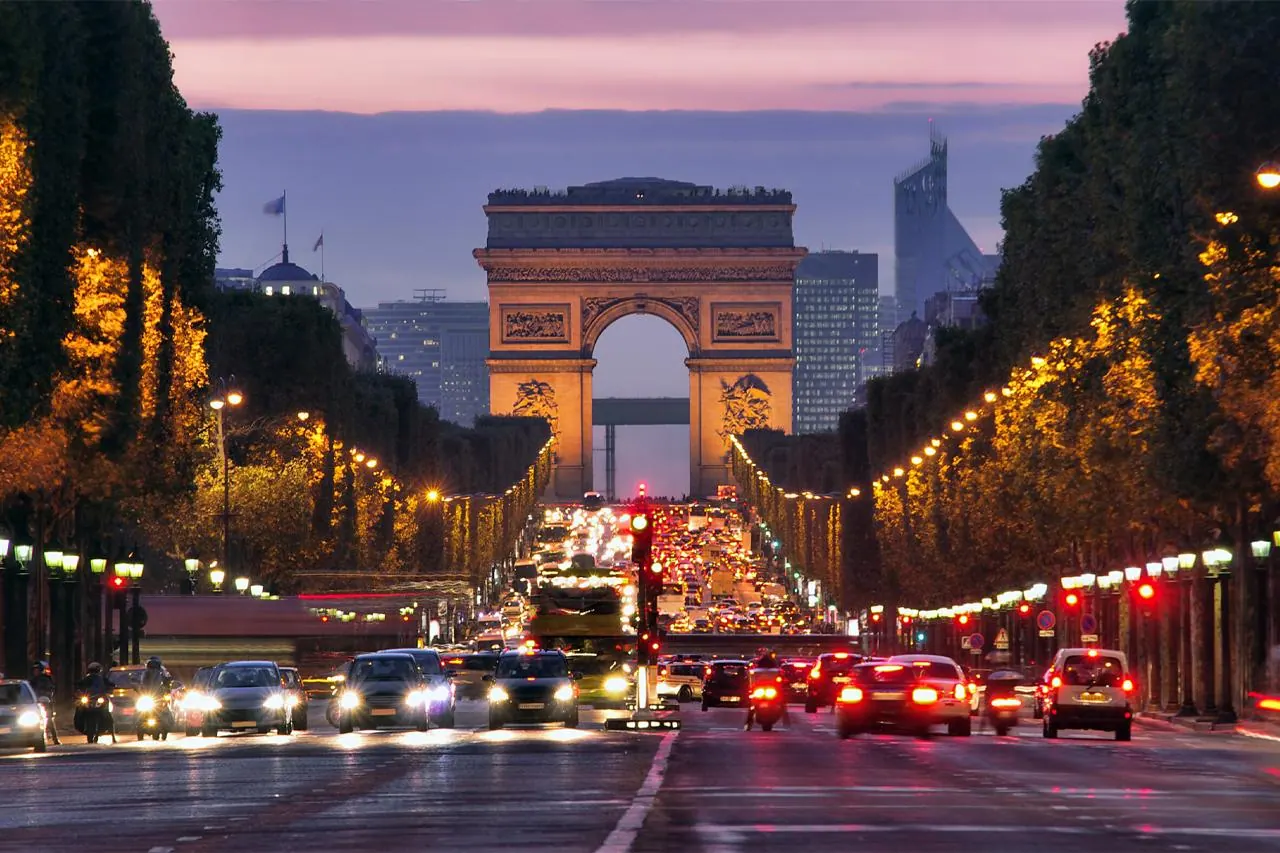
Geneva – Paris
Private Chauffeur from Geneva to Paris
About 545 km of motorway across the Jura and Burgundy, from your door in Geneva to your address in Paris.
- Door-to-Door Transfer
- Price Known Before Booking
- Baby & Booster Seats
- Available 24/7
Book your chauffeur
- Mercedes Benz E-Class: 25 km included per booked hour, then 3.00 CHF per extra km.
- Mercedes Benz S-Class: 25 km included per booked hour, then 6.00 CHF per extra km.
- Mercedes Benz V-Class: 25 km included per booked hour, then 3.60 CHF per extra km.
Add all your stops: the route is calculated by Google Maps and any extra kilometres are added to the price.
NB : Each time you change the information you will need to press the Price Estimate button.
Geneva to Paris by road: a long drive, and sometimes the simplest option
Between Geneva Airport and the centre of Paris lie about 545 kilometres of motorway and a little over six hours at the wheel. It is not a journey people make out of habit: there is a train and there are flights, and both are often quicker. Even so, we are regularly asked for a private chauffeur from Geneva to Paris, because some trips do not look like a simple station-to-station hop: a family with ten suitcases, an executive who has calls to make that nobody should overhear, a midnight departure, an address in Versailles or Marne-la-Vallée, a strike day.
Below you will find the route as it really is, a frank comparison with the high-speed train and the plane, and then the detail of the arrival: the gates of Paris, its districts, stations, airports and exhibition centres.
Geneva to Paris in brief
- Price From CHF 1935 one way in a Mercedes E-Class. Indicative price: the exact price is shown in the booking module.
- Distance About 545 km from Geneva Airport to central Paris
- Travel time About 6 h 15 of driving, or 6 h 30 to 7 h with one break
- Motorways A40 via Nantua and Bourg-en-Bresse, then the A6 from Mâcon to Paris
- Border Bardonnex customs post, on the way out of Geneva
- Halfway point Beaune, about 235 km from Geneva
- Arrival Porte d'Orléans or Porte d'Italie, then your address
- Departure At the hour you choose, day or night, by reservation
Train, plane or chauffeur-driven car: what each does best
Let us be plain: for one person with one suitcase going from the centre of Geneva to the centre of Paris, the train wins. The TGV Lyria links Cornavin station with the Gare de Lyon in a little over three hours, several times a day. A flight to Charles de Gaulle or Orly lasts just over an hour; once check-in, security and the ride into town are added, door to door is closer to three and a half or four hours. The car needs six and a half to seven.
So nobody chooses the road to save time. They choose it for other, very practical reasons:
- There are several of you. A family or a team travels in a single vehicle with pushchairs, trunks or equipment, and nothing has to be carried from one platform to another.
- Your address is nowhere near a station. Versailles, Disneyland Paris, Chantilly, a château in the Île-de-France or a terminal at Charles de Gaulle: the car goes straight there, with no metro ride across the capital.
- Your timetable is not the railway's. Leaving after dinner at 10 pm, or at 4 am to be in a meeting at 11, can only be done by road.
- You need to work or speak freely. Six hours in a closed car allow phone calls and document reviews that a railway carriage does not.
- You are carrying things that cannot be checked in. Collections for a trade fair, samples, dresses for a show, artworks or instruments stay where you can see them.
- The train or the plane lets you down. A strike, a cancelled flight, fog at the airport, fully booked trains on a holiday weekend: the road stays open.
If none of these applies to you, take the TGV; we will gladly drive you to Cornavin.
The road in four stages: Geneva basin, Jura, Bresse, Burgundy
Leaving Geneva. Your chauffeur joins the bypass motorway, clears customs at Bardonnex and heads west on the A40. First comes the Vuache tunnel, then the Bellegarde viaduct high above the Rhône: within half an hour the Geneva basin is behind you.
The Jura. Between Bellegarde and Pont-d'Ain the A40 is nicknamed the “motorway of the Titans”. It strings together viaducts and tunnels along the mountainside above Nantua and its lake, before the Chamoise tunnel, more than three kilometres long. This is the most spectacular part of the trip, and the only one where the speed limit stays low for any length of time.
The Bresse plain. After Pont-d'Ain the landscape flattens abruptly. The A40 passes Bourg-en-Bresse at a distance, runs due west, crosses the Saône and meets the A6 at Mâcon. You are a little under two hours from Geneva.
Burgundy, then the Île-de-France. The A6 heads north past Tournus, Chalon-sur-Saône and Beaune, where the vineyards of the Côte come right up to the carriageway. It then climbs onto the Burgundy plateau, above 500 metres, passes Pouilly-en-Auxois, Avallon and Auxerre, and drops towards Nemours and the forest of Fontainebleau. The final kilometres run alongside Évry and Orly Airport, where the motorway splits into two branches, one for the Porte d'Orléans and one for the Porte d'Italie.
Breaks, weather and busy hours
A break of twenty minutes or so is planned near Beaune, the halfway mark. You may ask for more, or turn the stop into lunch in the old town. In winter, fog and snow affect two sectors: the heights around Nantua and the Burgundy plateau. They slow the journey down far more often than they stop it.
The real variable is the approach to Paris. Between 7 and 10 am, and again from 4.30 to 8 pm, the last thirty kilometres can take an hour. On Sunday evenings the A6 brings weekenders back to the capital, and on summer Saturdays this “Autoroute du Soleil” is heavy in both directions. Leaving Geneva at about 9.30 am, for a mid-afternoon arrival, avoids most of it.
Entering Paris: ring road, gates and districts
Paris proper is encircled by the boulevard périphérique, a 35-kilometre ring road limited to 50 km/h since October 2024. The historic heart, the first four arrondissements, became a limited-traffic zone in November 2024: cars may no longer cut through it, only enter it to reach a destination there, which is exactly what happens when we drop you at your hotel. Your chauffeur picks the gate that suits your address.
- Golden Triangle and Champs-Élysées (8th): Avenue Montaigne, Avenue George-V, Rue du Faubourg-Saint-Honoré. The district of palace hotels, couture houses and many corporate headquarters.
- Vendôme, Opéra, Louvre (1st, 2nd, 9th): Place Vendôme and Rue de la Paix for jewellery, Rue de Rivoli, the department stores of Boulevard Haussmann.
- Left Bank (6th, 7th): Saint-Germain-des-Prés, the ministries, UNESCO headquarters on Place de Fontenoy, the Eiffel Tower.
- The Marais and the islands (3rd, 4th): narrow streets and old mansions, with a drop-off as close to the door as the street allows.
- 16th and Porte Maillot: Trocadéro, Avenue Foch, the OECD headquarters at La Muette, the Palais des Congrès.
- La Défense: the business district, to the west and outside the city limits. It is reached by the A86 or the western ring road without going through the centre.
Many of these journeys in fact connect international Geneva with its Parisian counterparts: delegations moving from the organisations around the Place des Nations to UNESCO or the OECD, bankers expected in the 8th, watchmakers and jewellers heading for Place Vendôme.
Stations, airports and exhibition centres
Stations. If Paris is only a stage, we take you to the station you need: the Gare du Nord for the Eurostar to London, Brussels or Amsterdam, Montparnasse for the west and south-west of France, the Gare de l'Est for Reims, Strasbourg and Germany.
Airports. Orly is the easy one: it sits beside the A6, some fifteen kilometres before the Porte d'Orléans. Charles de Gaulle lies on the opposite side, to the north-east; it is reached by the outer ring motorways without entering Paris, and takes three quarters of an hour to an hour longer than the city centre. Le Bourget, on the same road, is the business aviation terminal.
Trade fairs. Paris Expo Porte de Versailles, in the 15th, is very close to where the A6 arrives. Paris Nord Villepinte is next door to Charles de Gaulle. The Palais des Congrès stands at Porte Maillot, and the Grand Palais, reopened after its renovation, at the foot of the Champs-Élysées.
Without entering Paris: Fontainebleau, Versailles, Disneyland, Chantilly
A good share of these journeys are not bound for Paris itself. Fontainebleau is on the way: the car leaves the A6 some sixty kilometres short of the capital for the château, the INSEAD campus or Barbizon. Versailles is approached from the west, Disneyland Paris and Marne-la-Vallée from the east, skirting the built-up area. Chantilly, with its château and racecourse, is about fifty kilometres to the north. In each case the car spares you the crossing of Paris and one or two changes of train.
Dates that change the traffic
Paris moves to the rhythm of its big occasions, and some of them weigh on the roads as much as on the hotels:
- Fashion Weeks, in January, late February to early March, late June and late September: the Golden Triangle and the Left Bank slow to a crawl.
- Roland-Garros, from late May to early June, at Porte d'Auteuil.
- The Paris Air Show at Le Bourget, in June of odd-numbered years.
- 14 July: the Champs-Élysées and the Place de la Concorde are closed for the parade.
- The Prix de l'Arc de Triomphe, on the first Sunday of October at ParisLongchamp.
- The major trade fairs at Porte de Versailles and Villepinte, from Rétromobile in winter to Maison&Objet in January and September.
Tell us the name of the event when you book: the chauffeur plans the approach and the drop-off point around the announced closures.
Six hours on board: which vehicle to choose
Over this kind of distance, comfort matters more than on a one-hour transfer. The Mercedes S-Class is the natural choice for one or two people: legroom and quiet make all the difference after four hours. The E-Class suits a business traveller very well. The V-Class van is the answer for a family, a small group or a lot of luggage. The Sprinter minibus carries a delegation or a whole team in one vehicle.
Our chauffeurs are experienced, speak several languages and know how to stay in the background while you work. Baby seats and booster seats are fitted free of charge if you ask for them in advance.
Booking a Geneva – Paris journey
The online form accepts any pick-up and drop-off address: airport, hotel, home or office. The fare for the journey appears for each vehicle before you confirm, and payment is made online by card. Motorway charges and parking fees are payable by the client unless the offer you receive says otherwise.
If you start from the airport, the chauffeur waits in the arrivals hall holding a sign with your name, and your flight is tracked. The journey can equally be booked in the other direction, from Paris to Geneva, and the car can stay at your disposal in Paris on an hourly basis.
Practical guide : Geneva Airport to Paris: Travel Time, Route and Transport Options
Frequently asked questions
Frequently asked questions about travelling from Geneva to Paris by chauffeur-driven car
How long is the drive from Geneva to Paris?
Allow about 6 h 15 of driving for 545 kilometres, and 6 h 30 to 7 h door to door with a break. Reaching Paris at rush hour can add half an hour to an hour.
Isn't the train faster?
Yes, from centre to centre: the TGV takes a little over three hours. The car becomes the better choice when you are several people, heavily laden, expected far from a station, or when your hours match no train.
Which motorways do you use?
The A40 from the border to Mâcon, through Bellegarde, Nantua and Bourg-en-Bresse, then the A6 all the way to Paris via Beaune and Auxerre.
Do you stop along the way?
Yes, one stop is planned around the halfway point, usually near Beaune. You can ask for others at any time, or book a longer stop for lunch.
Can we leave straight from Geneva Airport after a flight?
Yes. Your flight is tracked and the chauffeur meets you in the arrivals hall; sixty minutes of waiting after landing are part of the service.
Can you drive us to Charles de Gaulle, Versailles or Disneyland Paris?
Yes. Give the exact address: the fare is calculated for that destination, and the car goes round Paris instead of through it.
Who pays the motorway charges?
Both the A40 and the A6 are pay motorways. Under our terms and conditions, those road charges and any parking are borne by the client, unless your offer states something different.
Is it possible to travel overnight?
Yes, the service runs around the clock by reservation. A late-evening departure gets you to Paris in the early morning, ahead of the traffic.
Which vehicle do you recommend for such a long trip?
The S-Class for one or two people who want to rest or work, the V-Class as soon as you travel as a family or a group, the Sprinter for a complete team.
Do you take young children?
Yes. Baby seats and boosters are supplied at no extra cost; simply tell us the children's ages, and allow for one or two additional breaks.
How is payment made?
By card, online and before departure: Visa, Mastercard, Maestro or American Express, on a Stripe payment page.
What if I have to cancel?
Up to 72 hours before departure you are refunded in full. Between 72 and 48 hours, half of the amount is refunded. Within 48 hours, or if you do not show up, the journey remains payable.
Can the chauffeur stay in Paris during our visit?
Yes, with the hourly option, from two hours upwards: back-to-back meetings, an evening out, a trade fair or a visit outside the city.
Ready to book your chauffeur?
Get your price online in a few seconds, or contact us on WhatsApp — we answer 24/7.