
Practical guide
Which Limousine to Choose in Geneva: Saloon, Van or Minibus?
Chauffeur companies sort their cars into four families. Here is what sets them apart and how to decide.
Which limousine to choose in Geneva: a question to settle before the price
Anyone comparing chauffeur-driven car offers in Geneva runs into the same headings: “business”, “first”, “van”, “minibus”. Those labels hide very different sizes of vehicle, and picking the wrong limousine has immediate effects: suitcases on laps, a crumpled dress or, at the other extreme, a half-empty minibus. This guide describes the four families, then suggests a simple method to help you choose with confidence.
- Business saloon Mercedes E-Class type: up to three travellers, everyday luggage
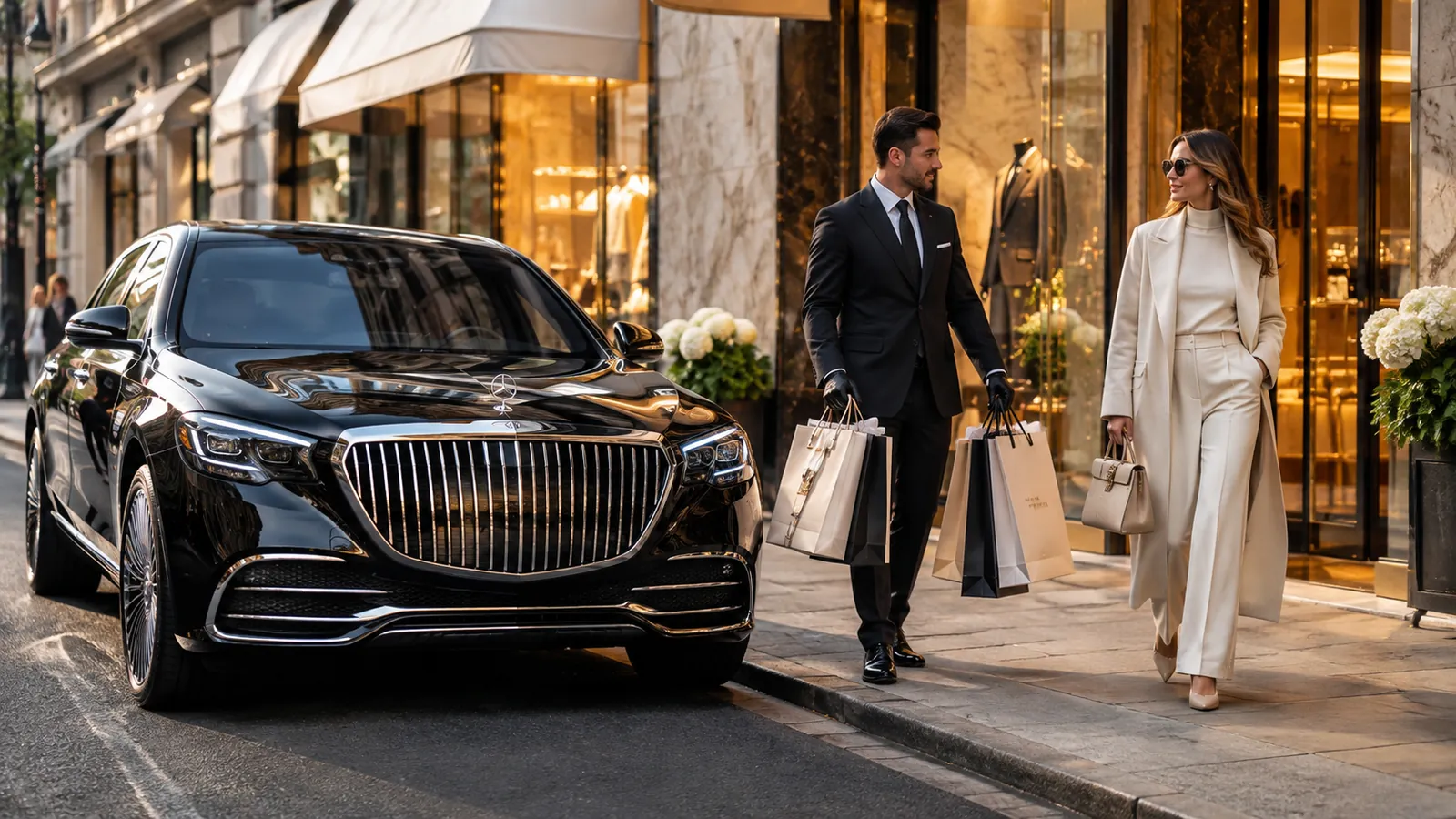
- Luxury saloon Mercedes S-Class type: same capacity, markedly better rear comfort
- Van Mercedes V-Class type: families, small groups, bulky luggage
- Minibus Mercedes Sprinter type: groups wishing to travel together
- Stretched limousine Uncommon in Switzerland, kept for party entertainment
Where the word comes from, and why it causes confusion
The term is said to come from the Limousin region of France: it first described a car whose driver sat apart from the passengers. Everyday English and French now picture an outsized automobile; German uses it for a plain saloon with a boot. Switzerland, a multilingual country, settled on a meaning in between: a limousine is any car of a certain standing hired together with its driver. Which is why a black E-Class parked outside a Geneva hotel can carry that name with no misuse of language.
The four families, one by one
The business saloon
This is the workhorse of the trade. Four doors, a separate boot, three passenger seats of which two in the back are properly comfortable. It takes two large suitcases and two cabin bags. You see it everywhere because it suits the majority of journeys: meeting a flight, an appointment in town, an hour on the motorway.
The luxury saloon
It carries no more people: what you pay extra for is space and calm. The longer wheelbase frees up legroom, the rear seats adjust, and the cabin filters noise more effectively. The difference is felt mostly beyond an hour on the road, or when you need to make calls, read or sleep. It is also the car of protocol, the one people expect for a guest of honour.
The van
Sliding doors, a flat floor, headroom: a van changes how you get in and settle down. It resolves the situations where a saloon reaches its limits, such as a family with a pushchair, four friends with their skis or travellers laden with garment bags. Some models allow the seats to be arranged face to face. The other side of the coin: its height rules out a few older underground car parks, and its look remains more utilitarian.
The minibus
Beyond the capacity of a van, two answers exist: several cars or a single minibus. The latter keeps the group in one place, which simplifies timings and keeps the conversation going. On the other hand it needs more open drop-off points than an alley in the old town.
Five criteria for deciding
1. The people. Count every traveller, children too. A baby seat takes up a whole place and narrows the width left for the neighbours.
2. The luggage. This is the most frequent oversight. Three adults fit in a saloon; their three large suitcases plus a golf bag may not. Skis, musical instruments, exhibition cases: declare everything out of the ordinary.
3. The duration. For twenty minutes between the airport and the centre, the category matters little. For two and a half hours to a resort in the Tarentaise, seat comfort becomes a real subject.
4. The occasion. Evening wear or a wedding dress calls for ease in getting in and out. A work trip calls rather for the sobriety of a saloon.
5. The places. A narrow lane leading to a chalet, a cramped hotel courtyard, a pedestrian zone: the size of the vehicle has to match the access. A good operator raises the question unprompted.
Three classic mistakes
The first is to think in numbers of seats. A “four-seater” car counts the front passenger seat, where nobody wants to sit on an evening out with friends.
The second is to underestimate winter. Between December and March, people land in Geneva with down jackets, ski boots and two-metre ski bags. The volume doubles compared with summer.
The third, less common, is to oversize. Reserving a minibus for a small, lightly loaded party costs more and complicates access to addresses in the centre, for no real benefit.
One large vehicle or two small ones?
As soon as a party is too large for one saloon, the question comes up constantly. A single van simplifies everything: one timetable, one meeting point, one chauffeur to reach. Two saloons give more flexibility if the group splits along the way, for instance when half the passengers get out in Lausanne and the others carry on to Montreux. So ask yourself just one thing: does the group stay together from start to finish?
What to ask before reserving
Whoever the operator is, a few checks prevent misunderstandings. Is the model advertised guaranteed, or only the category? Does the rate apply to the whole vehicle or per person? Are child seats supplied? Is waiting provided for if the plane is late? In winter, is the car equipped for the mountains, as French regulations demand in high-altitude municipalities from 1 November to 31 March? A serious professional answers all of that in writing, and will not mind being asked.
Frequently asked questions
Frequently asked questions
What is the difference between a business saloon and a luxury saloon?
The number of seats is identical. The luxury saloon brings more legroom, adjustable rear seats and a quieter cabin, which counts above all on long journeys.
Do three adults with three large suitcases fit in a saloon?
It is often tight. If each traveller adds a cabin bag, it is wiser to move up to a van so that nothing ends up on the seats.
Do two people need a van to go skiing?
Not necessarily. Mention the ski bags: depending on their length a saloon may be enough, otherwise a van is the answer.
Can stretched limousines be found in Geneva?
They are uncommon and belong to party entertainment rather than conventional chauffeur-driven transport. Most Geneva companies work with saloons, vans and minibuses.
Is the price worked out per person?
No, as a general rule: you reserve the whole vehicle. The cost per traveller therefore falls as the seats fill up.
Is a van less comfortable than a saloon?
It is different. You gain height and ease of access; you lose a little in rolling quietness compared with a luxury saloon.
From how many people is a minibus needed?
As soon as the group exceeds the capacity of a van, luggage counted. Give the operator the exact headcount and you will be told whether a minibus or two vehicles suit better.
More guides
-
Geneva Airport to Aix-en-Provence: How to Get There
An out-of-town TGV station, two road itineraries, door-to-door times: the journey from Geneva to Aix-en-Provence explained.
Read the guide
-
Geneva Airport to Aix-les-Bains: The Journey Guide
Direct train from Cornavin, the A41 or a chauffeur: the trip from Geneva Airport to Aix-les-Bains, with useful advice for spa visitors.
Read the guide
-
Geneva Airport to Alpe d'Huez: Travel Time, Route and Transport Options
215 km via Grenoble, a little over three hours: a guide to travelling from Geneva Airport to Alpe d'Huez, and to deciding whether Geneva is the right choice.
Read the guide
Ready to book your chauffeur?
Get your price online in a few seconds, or contact us on WhatsApp — we answer 24/7.