
Practical guide
Organising Ground Transport for Company Visitors in Geneva: A Seven-Step Method
From the first e-mail to the next day's review: a countdown plan for the assistant, the site manager or the offsite organiser.
Organising ground transport in Geneva for visitors: a project in its own right
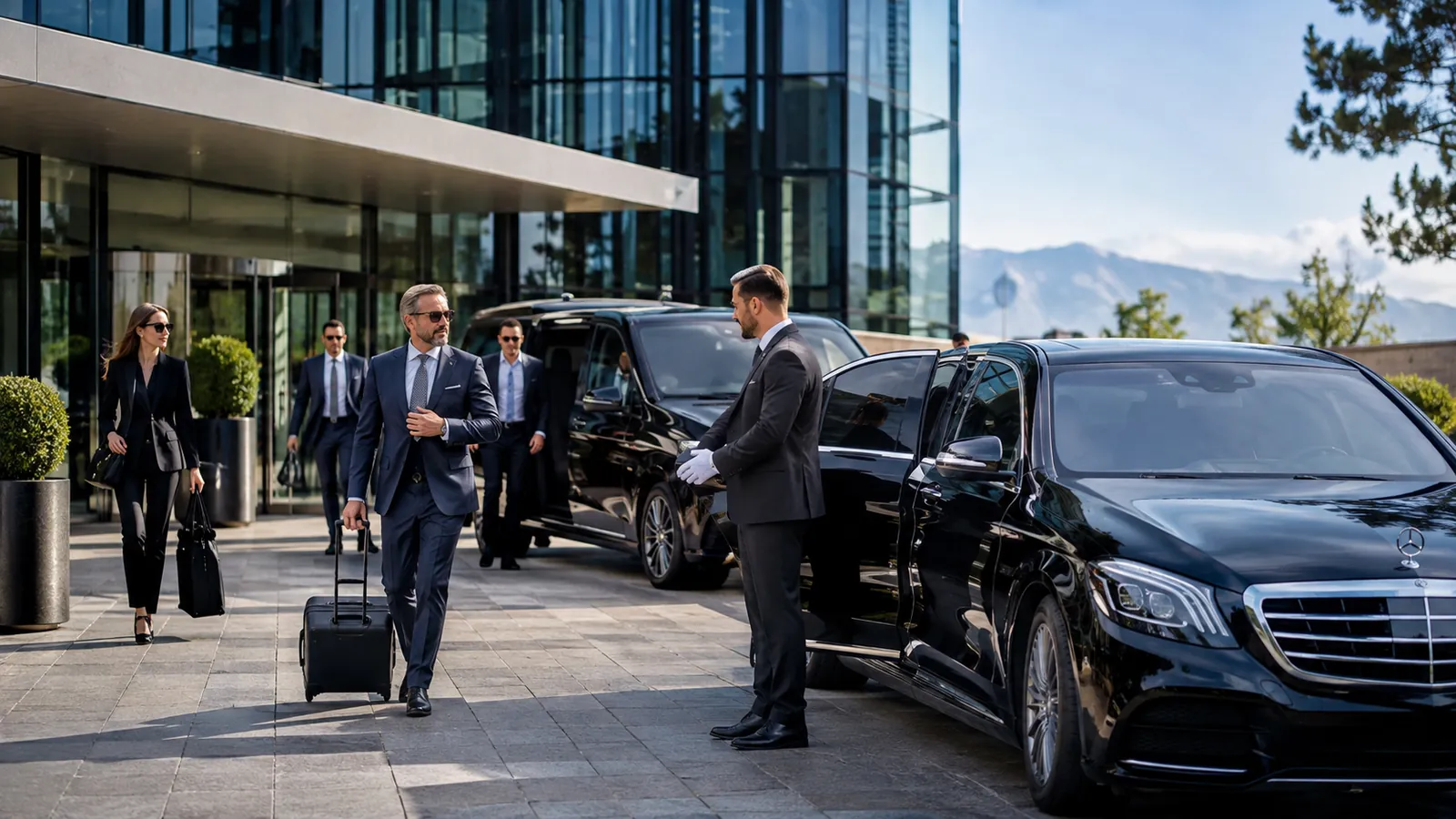
The room is booked, the bedrooms blocked, the caterer ordered, and everyone assumes the journeys will sort themselves out. Yet they are what the first impression rides on. Organising ground transport in Geneva for company visitors, be there six or sixty, calls for the same rigour as the rest of the event and is prepared by counting back from the day itself. Here is a seven-step method that holds good for a leadership visit as much as for an offsite.
- A month before Take stock of the participants and the places
- Three weeks before Choose the transport mode for each leg
- Two weeks before Draw up the list of names with flights
- A week before Confirm and circulate instructions
- Three days before Freeze the arrangements
- On the day One lead contact, one number, one document
Step 1: take the inventory
Begin with three lists. The people: how many, where they are coming from, what their rank is. The places: airport, railway station, hotels, company site, restaurants. The moments: arrivals, movements during the stay, the evening, departures. At this stage approximations are enough; the aim is to measure the scale of the arrangements, not to fix their details.
Step 2: choose a transport mode for each leg
Nothing obliges you to use the same answer from beginning to end. A good plan often combines several means.
- The train suits participants arriving alone from another Swiss city whose hotel is close to Cornavin station.
- A chauffeur-driven car is the natural choice for executives and guests arriving by air, for night-time schedules and for poorly served sites.
- A van or minibus with driver takes over as soon as several people land within a short interval or move about together.
- A coach becomes relevant beyond a few dozen participants on the same journey.
- Walking and public transport are sufficient between a hotel and a restaurant in the centre, provided you announce it so that everyone brings suitable shoes.
The deciding criterion is not prestige but the reliability of the timetable: the more a leg determines the start of a session, the less it should be left to chance.
Step 3: build the passenger list
This is the central document, the one professionals call the manifest. A plain table, with one row per person and, in columns: surname and first name, mobile number, arrival flight or train number, scheduled time, hotel, return flight number, remarks. The remarks column takes anything out of the ordinary: reduced mobility, bulky luggage, travelling with a spouse.
Keep a single, dated version of this table and ban partial copies sent by several people. Almost every transport incident can be traced to an out-of-date list.
Step 4: group the arrivals
Sort the list by landing time. Clusters emerge: three people between 8.30 and 8.50 am, five at around 10, a lone traveller at noon. Each cluster corresponds to a vehicle. Set yourself a maximum waiting rule, half an hour for example, beyond which the first to arrive is not kept hanging about. Remember too that travellers coming from a country outside the Schengen area go through passport control, which lengthens their exit.
Step 5: confirm and inform
A week ahead, send the list to the operator and ask for written confirmation of each pick-up. Then inform the travellers. A short message will do: where the chauffeur will be, how to recognise him, which number to dial in case of difficulty. Avoid sending them the complete table; each person needs only his or her own row.
Step 6: freeze the arrangements
The cancellation conditions of transport operators generally tighten as the date approaches, often in the final two or three days. So set an internal deadline ahead of that threshold for gathering withdrawals. Once that point has passed, change only what is indispensable, and record every alteration in the list.
Step 7: hold the roles on the day
When the day comes, three functions have to be clearly assigned. The lead contact, reachable at all times, settles the unexpected. The greeter, at the site or the hotel, ticks off the arrivals. The operator follows the flights and allocates the vehicles. All of them work from the same document.
The next day, take ten minutes to note what worked and what was missing. That review, attached to the table, will be the starting point for the next visit.
What about the budget?
Always ask for a costing per leg in preference to an overall package: that way you see what each decision costs, for example an individual car for a board member or an extra vehicle to shorten a wait. Check what the amount covers when a plane is late and what is kept separate, such as parking. A detailed quotation lets you weigh things up with full knowledge of the facts; a single total with no breakdown does not. It also makes the conversation with your finance department a good deal shorter.
Five mistakes found everywhere
Forgetting the return journeys. All the energy goes into arrivals, and departures are improvised as the last session breaks up.
Underestimating luggage. Ten people with ten suitcases do not fit in a vehicle meant for ten passengers without bags.
Ignoring the local calendar. In Geneva, a major trade fair or an international conference makes vehicles and rooms scarce several weeks ahead.
Confusing landing time with exit time. Between the two, twenty to forty-five minutes go by, depending on checks and baggage.
Multiplying the contacts. When three colleagues each send in their own amendments, nobody knows any longer which version is authoritative.
Frequently asked questions
Frequently asked questions
How far ahead should we start?
A month for a group, longer if the dates coincide with a fair at Palexpo or a major conference. For two or three visitors, a week is generally enough.
Is one car per person necessary?
No. Travellers whose arrivals are close together are grouped, within a maximum waiting time and with due regard for any order of precedence.
What must the passenger list contain?
At the very least the name, a mobile number, the outbound and return flight or train numbers, the hotel and any special needs.
What should visitors be told before they set off?
The meeting place on arrival, how to recognise the chauffeur and a number to call. Nothing more is required.
How do we handle a cancelled flight?
The lead contact passes the new flight to the operator at once and updates the list. If the arrival slips to the following day, check the hotel room as well.
Who should be the lead contact on the day?
Somebody who knows the programme, has the authority to decide and will not be sitting in sessions all day. That person's number appears on every message sent to the travellers.
One coach or several minibuses for forty people?
A coach if everybody leaves from the same place at the same time. Several minibuses if the hotels are scattered or the timings differ.
More guides
-
Geneva Airport to Aix-en-Provence: How to Get There
An out-of-town TGV station, two road itineraries, door-to-door times: the journey from Geneva to Aix-en-Provence explained.
Read the guide
-
Geneva Airport to Aix-les-Bains: The Journey Guide
Direct train from Cornavin, the A41 or a chauffeur: the trip from Geneva Airport to Aix-les-Bains, with useful advice for spa visitors.
Read the guide
-
Geneva Airport to Alpe d'Huez: Travel Time, Route and Transport Options
215 km via Grenoble, a little over three hours: a guide to travelling from Geneva Airport to Alpe d'Huez, and to deciding whether Geneva is the right choice.
Read the guide
Ready to book your chauffeur?
Get your price online in a few seconds, or contact us on WhatsApp — we answer 24/7.